 ur bicycling
futurist brought the Corner Cube
home and eagerly fashioned a bracket to fit the luggage
rack on his all-weather commuter bike. He waited
for nightfall and invited a friend to drive over for an
amazing demonstration of space-age technology. He
rolled the bicycle out of the workshop onto his
driveway.. ur bicycling
futurist brought the Corner Cube
home and eagerly fashioned a bracket to fit the luggage
rack on his all-weather commuter bike. He waited
for nightfall and invited a friend to drive over for an
amazing demonstration of space-age technology. He
rolled the bicycle out of the workshop onto his
driveway..
Illuminated by the headlights, the Corner Cube appeared
completely dark -- a black hole! -- as
viewed from inside the car. The query in the puzzle calls for an
explanation, which will be elementary for a
sophisticated solver who understands how a Corner Cube works...
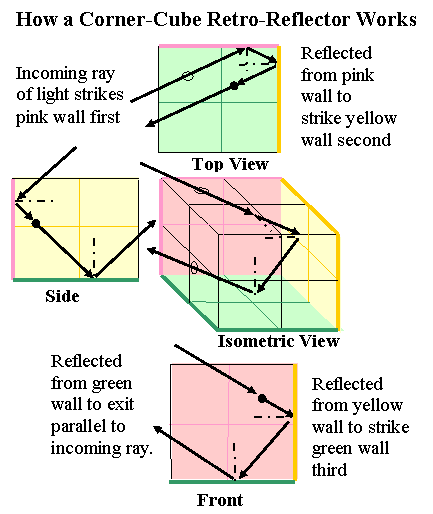
 ketches like
those above use two-dimensional views (Top, Side,
Front) to depict a three-dimensional phenomenon -- in
this case the pathway traced by a typical ray of light
inside a Corner Cube. Now, The Law
of Reflection can be stated as follows: "The
angle of incidence equals the angle of
reflection." It is customary to measure both
angles from a perpendicular line (normal) at
the point of reflection. In the sketches, normals
are indicated by dashed lines or by dots (for normals
that are -- well, normal to your screen). ketches like
those above use two-dimensional views (Top, Side,
Front) to depict a three-dimensional phenomenon -- in
this case the pathway traced by a typical ray of light
inside a Corner Cube. Now, The Law
of Reflection can be stated as follows: "The
angle of incidence equals the angle of
reflection." It is customary to measure both
angles from a perpendicular line (normal) at
the point of reflection. In the sketches, normals
are indicated by dashed lines or by dots (for normals
that are -- well, normal to your screen).
Nota bene: Viewed from
various points in space, the two angles -- incidence
and reflection -- may be foreshortened, but their equivalence
to each other will always prevail.
As shown in the sketches, an incoming ray
of light from a given angle will be reflected from all
three 'walls' of the Corner Cube and exit at the same angle in the
opposite direction. The solution for the puzzle, then, may be
summarized as follows:
|
All
rays of light that enter the Corner-Cube from the car's headlights
will be returned back into the headlights
not into the eyes of the driver.
|
Which invites another question: How do
normal bicycle reflectors work? You are
invited to submit your explanations here.
Epilog
Comments received from Myles Buckley
in May, 2008 are the best so far...
Upon detailed examination of
the rear reflector on my son's bicycle, with the
assistance of a tunable wavelength low-wattage laser
and a sensitive photocell, I can assert the following:
- Several plastics layers, each
with differing angles of refraction and each
pressed into an overlapping bezel, form triangular
segments similar to a Fresnel lens.
- The configuration allows a
significant percentage of the light entering the
reflector medium at an incident angle between 70
and 110 degrees to be refracted and
reflected back toward the light source with a
dispersion of five degrees.
- It was noted that dispersion
increases beyond five degrees with increasing
destructive interference.
- If an automobile headlamp is
considered a near point-source of light. The
angle of coherently refracted/reflected light at
up to five degrees deflection is well within a
nominal 0.6 to 2.5m vertical displacement between
a car (or transport truck) headlamp and its
driver's eyes.
Fairly impressive considering the
bicycle reflector is just pile of shaped plastic on
aluminum. Now, consider the effect on eye-brain
system of an interference pattern produced by the
Fresnel-type structure, featuring
refraction/reflection.
- Animal brains, including those
of humans, interpret ‘moving’ light sources and
‘pulsing’ light sources differently.
- A static light source (fixed in
the background, or moving at a relative velocity)
is somewhat ignored by the visual processing in
the visual cortex.
- Make that light “pulse”
incredibly fast (much faster than relative
velocity, like having interference patterns
rake-across the retina) and suddenly the brain
‘notices’ the source much easier.
Here is a simple way to test that
phenomenon: At a truck stop, from a standstill, look
for the reflector strips on a truck. Take a jog
at a tangent and observe the reflector strips.
Finally from a moving vs stationary observation point
observe again. In each case, you should note
that your movement or the target's movement increases
the visibility of the reflector strips.
The effect has
been exploited by the HIRL,
with life-saving results.
-- PN
|

