|
 There were
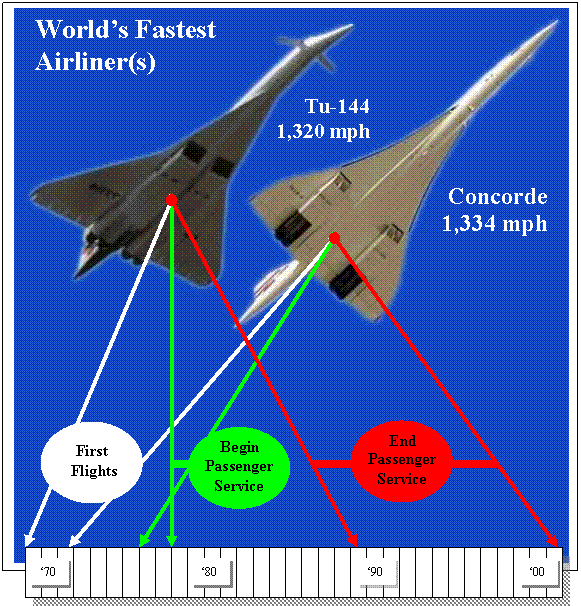
two. They were contemporaries and
rivals. Their respective developments
commenced in the sixties, during an extraordinary
era for technology worldwide. A prototype of a
supersonic airliner, the Tupolev Tu-144,
built in the USSR took its first flight on New Years Eve in 1968, followed
32 months later on September 4, 1971 with the first
flight of Concorde,
which was developed and built in a collaboration
between Aérospatiale and the British
Aircraft Corporation. There were
two. They were contemporaries and
rivals. Their respective developments
commenced in the sixties, during an extraordinary
era for technology worldwide. A prototype of a
supersonic airliner, the Tupolev Tu-144,
built in the USSR took its first flight on New Years Eve in 1968, followed
32 months later on September 4, 1971 with the first
flight of Concorde,
which was developed and built in a collaboration
between Aérospatiale and the British
Aircraft Corporation.
The US had been
conducting studies for a "supersonic transport"
(SST) since the early fifties. Boeing's
Model
2707 won a design competition in 1964 against
Lockheed's
L-2000
for an American SST, but the development program was
terminated in 1971 in recognition of the lead
already enjoyed by the Tu-144 and Concorde.
Meanwhile, something
else was taking center stage. The Soviet
Space Program had been scoring a steady
stream of technological firsts since Sputnik
in 1957. The "giant leap for mankind" on Mare Tranquillatis took
place 201 days after the Tu-144 first flew.
Eyes were glistening with pride on both sides of
the Iron
Curtain. From that point forward, there
would be no problems that could not be solved by
technology. "Bring on cancer," someone exulted.
Video
Comparison: Tu-144 versus Concorde
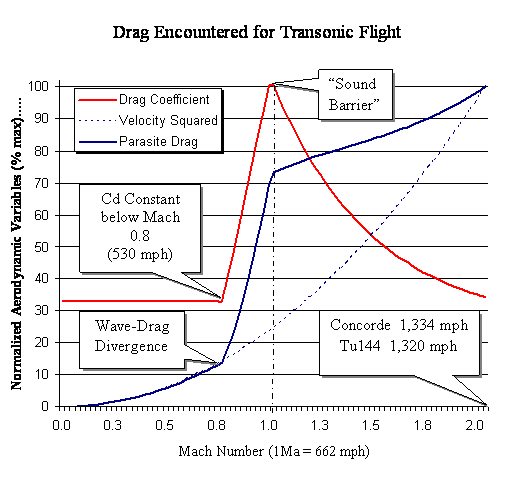
The challenges of
supersonic flight are immense. Upwards of 50 tons of
engine thrust are required to drive 200 tons of
hardware through the sky, overcoming drag, which
increases abruptly as the plane accelerates toward
what is popularly called the "sound barrier"...
Air friction
heats the skin, expanding the airframe by as much as
a foot in length. The nose tip temperature can
reach 260 °F (127 °C) at Mach
2. Then too, there are pesky aerodynamic
complications to deal with for enabling the world's fastest
airliner to fly slow -- like at
take-off and approaching to land.
As the technical problems are common, resemblances
between the Tu-144 and Concorde are striking
(delta wing, drooping nose cone), but there are
significant differences in their designs, too (for pitch
authority at low speed: a canard
in one, shifting fuel inside tanks along the
fuselage in the other).
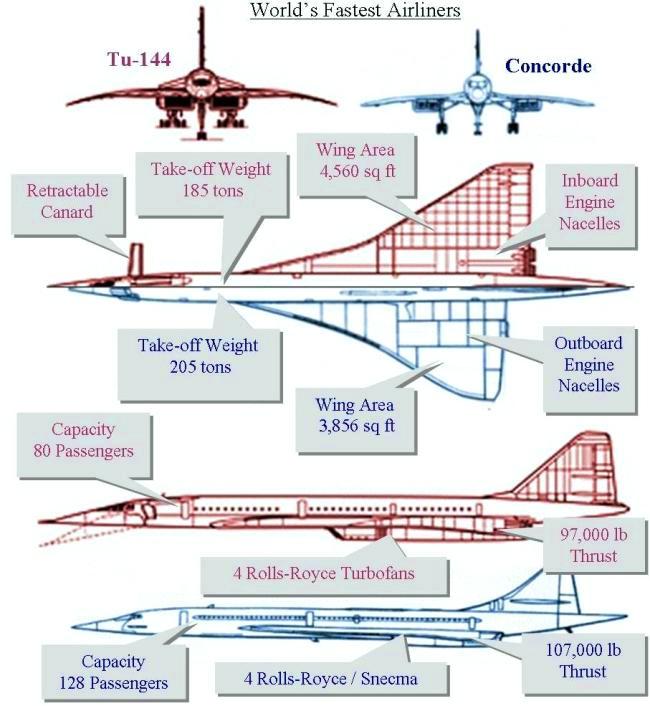
|
World's Fastest
Airliner(s)
|
|
Airliner
|
Tu-144
|
Concorde (The)
|
|
Country
|
USSR
|
UK & France
|
|
Manufacturer
|
Tupelev OKB
|
BAC /Aerospatiale
|
|
Nickname
|
"Konkordski"
|
"Speedbird"
|
|
Cruise Speed
|
1,320 mph
|
1,334 mph
|
|
Quantity Built
|
16
|
20
|
|
Take-off Weight
|
185 tons
|
205 tons
|
|
Range
|
4,039 miles
|
4,500 miles
|
|
Capacity
|
80 Passengers
|
128 Passengers
|
|
Flights
|
Weekly
|
Daily
|
|
Distinctions
|
Canard
Brake Chute
|
Fly-by-Wire
Trim by Fuel CG
|
|
Issues
|
Failures: 226 in
122 Flights
|
Sonic
Boom
Take-off Noise
|
Try to
imagine this: Concorde was forbidden to fly
at supersonic speeds over inhabited areas!
Note the exclamation point, the only one in this
puzzle. The thought must have been that by
flying high enough, an SST would avoid the most
troublesome environmental impact -- sonic
boom.
Concorde had a service
ceiling of 60,000 feet MSL.
That's more than eleven miles straight up.
One would surely expect that the inverse
square law would apply -- that no airplane
flying in the stratosphere
would be found guilty of spooking farm animals or
rattling school windows. Such a happy notion
was demolished when test flights of the North
American B-70
Valkyrie were carried out in the mid-1960s,
not to mention the Operation
Bongo fiasco about that time. Bummer.
The expression sonic
boom is misleading. "Sonic" has nothing
to do with it. "Over-pressure boom" would be
more to the point. Over-pressure followed by
under-pressure in quick succession -- but far below
the frequency of ordinary sound
waves.
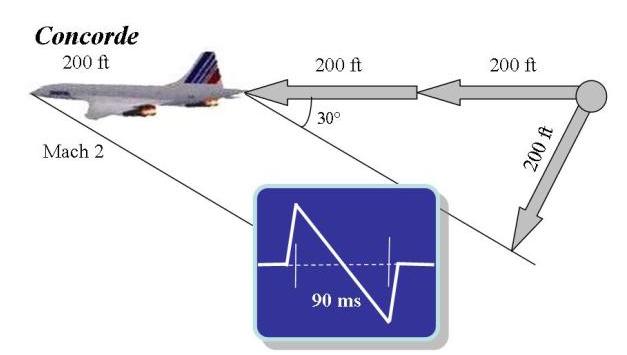
In the sketch above,
we see the characteristic "N-wave"
produced by Concorde flying at twice the
speed of sound. An abrupt rise in pressure at
the nose results from compression of the air and an
abrupt fall in pressure at the tail results from the
air returning to its undisturbed state.
The speed of sound is
about 1,100 ft/sec.
At 200 feet in length, the fuselage of Concorde
traveling at twice the speed of sound passes a
given point in about 90 ms.
Meanwhile, the N-wave from that point in the sky
moves outward in a circular ring at the speed of
sound, forming a shock
cone, which diverges from the flight path by
30o and will be experienced on the
ground as a double-boom.
At supersonic
speeds, Concorde streaked across the sky
unheard on the ground, with its passengers inside
unaware that objects and
people were being hammered by a pair of unwelcome shock
waves -- "baboom"
-- along a swath of ground. Flying high was
doing little to attenuate the intensity of the
detonations, only increasing the width of
the swath and thus the area impacted.
What remedies for the sonic
boom would you propose that might enable the world's
fastest airliner to fly at supersonic speeds over
inhabited areas?
|
{1} Airspeed:
Faster or Slower?
{2} Fuselage:
Lengthen or Shorten?
{3} Wingspan:
Longer or Shorter?
{4} Shape of the
Aircraft: Redesign?
|
GO
TO SOLUTION PAGE

|