|
Word Origin hypoteneese (n) plural of hypotenuse Copyright ©2008 by Paul Niquette. All rights reserved.. |
||||||||||||
 ack in some
indefinitely early age, we have been taught the
Pythagoras Theorem, "The square of the hypotenuse of
a right triangle is equal to the sum of the squares on
the other two sides." For more than 25
centuries, the Theorem has been learned and found
useful. Never mind that in modern times it has
been misquoted in a popular film and
lampooned in a world-class groaner. ack in some
indefinitely early age, we have been taught the
Pythagoras Theorem, "The square of the hypotenuse of
a right triangle is equal to the sum of the squares on
the other two sides." For more than 25
centuries, the Theorem has been learned and found
useful. Never mind that in modern times it has
been misquoted in a popular film and
lampooned in a world-class groaner.
Just as famous in our scholastic youth was the "three|four|five triangle," wherein integers 3 and 4 provide the dimensions for the two sides and 5 represents the length of the hypotenuse. Accordingly, the square of five (52 = 25) equals the square of three (32 = 9) plus the square of four (42 = 16). An unlimited number of triangles can
each have 5 for their hypoteneese. The square of
their common hypotenuse 25 can be produced as the sum
of 12 integer pairs...
The members of only one pair, 9+16=25,
are both squares of integers. The dimensions in
other pairs are generally not integers, one or both
will be irrational numbers formed as products,
each pair including the square root of at least one prime
integer...
In mathematics, positive integers are also called natural numbers. For Natural Hypoteneese puzzle, we shall define a natural hypotenuse as an integer that can be formed as the square root of the sum of the squares of two integers. The "three-four-five triangle" offers the smallest natural hypotenuse. Don't you wonder how many other right triangles exist that have integers for all three sides?
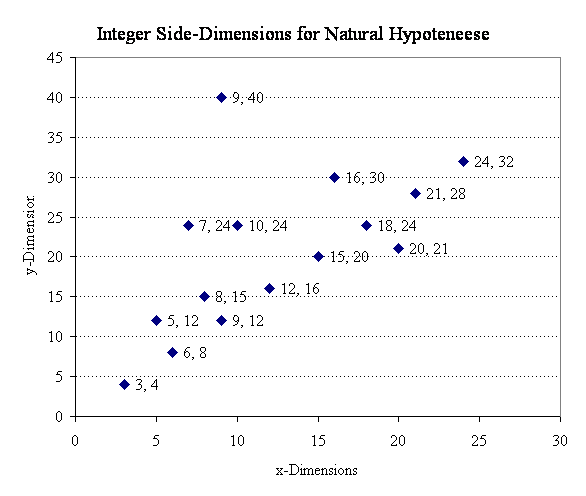
 here is something interesting about
the 5|12|13 triangle. As with any triangle
having a natural hypotenuse, 5|12|13 is the first member
on a straight line in the graph indicating a family of
Natural Hypoteneese, each member being formed
by multiples. The graph shows 5n|12n|13n
producing 10|24|26 for n = 2. here is something interesting about
the 5|12|13 triangle. As with any triangle
having a natural hypotenuse, 5|12|13 is the first member
on a straight line in the graph indicating a family of
Natural Hypoteneese, each member being formed
by multiples. The graph shows 5n|12n|13n
producing 10|24|26 for n = 2.
The triangle
5|12|13 is also the second member of another
whole family, which begins with our old friend the
"three|four|five triangle." This family of Natural Hypoteneese includes 7|24|25 and 9|40|41, which
you will notice do not lie along a straight
line in the graph.

|
||||||||||||
 epicted in
the graph below are the dimensions of 15 triangles
with Natural Hypoteneese
plotted according to the lengths of their
non-hypoteneese. The "three|four|five triangle"
sits in the lower left corner of the graph. Some
observations...
epicted in
the graph below are the dimensions of 15 triangles
with Natural Hypoteneese
plotted according to the lengths of their
non-hypoteneese. The "three|four|five triangle"
sits in the lower left corner of the graph. Some
observations...