
Copyright ©1997 by Paul Niquette. All rights reserved. |
|
Copyright ©1997 by Paul Niquette. All rights reserved. |
  he
sophisticated solver of this
puzzle knows that
the resistance of a conductor depends on the
"resistivity" of the material
out of which it is made and is furthermore directly
proportional to the
length of the conductor and inversely proportional to
its crossectional
area. he
sophisticated solver of this
puzzle knows that
the resistance of a conductor depends on the
"resistivity" of the material
out of which it is made and is furthermore directly
proportional to the
length of the conductor and inversely proportional to
its crossectional
area.
Now, a conventional conductor, like a
wire, has a constant
crossectional area, so the resistance varies with its
length. The earth
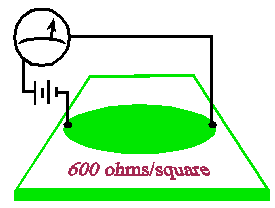
forms what is called a "sheet resistor"...
The engineering unit for sheet resistance is "ohms per square." Hey, ohms per square what?
|

|
|
|
|
|