|
Aviate,
Navigate, Communicate -- in that order.
|
 On
July 2, 1937 at 0000 GCT, the Lockheed Electra Model
10E began its take-off roll at Lae, New Guinea.
It was the beginning of a tragic flight and the
biggest aviation mystery in history. The
over-water flight of 2,556 miles along the Equator to
Howland Island would place extreme demands on all
navigation resources and skills of that time.
The navigator for the round-the-world
adventure was arguably the best in the world, Fred
Noonan. Nevertheless, the successful conclusion
of the flight could be assured only by RDF --
Radio Direction Finding (see Live
Reckoning) performed by the Pilot-in-Command,
Amelia Earhart. On
July 2, 1937 at 0000 GCT, the Lockheed Electra Model
10E began its take-off roll at Lae, New Guinea.
It was the beginning of a tragic flight and the
biggest aviation mystery in history. The
over-water flight of 2,556 miles along the Equator to
Howland Island would place extreme demands on all
navigation resources and skills of that time.
The navigator for the round-the-world
adventure was arguably the best in the world, Fred
Noonan. Nevertheless, the successful conclusion
of the flight could be assured only by RDF --
Radio Direction Finding (see Live
Reckoning) performed by the Pilot-in-Command,
Amelia Earhart.
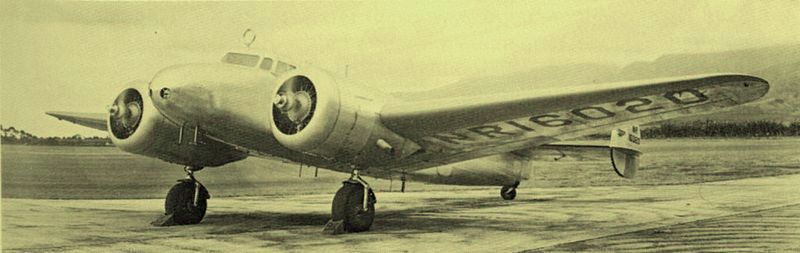
Aviating,
Navigating, Communicating (in that order)
Piloting requires multitasking
aloft. Each task has its own primacy; each is a sine qua
non for the successful completion of every
flight. Contrary to the simplistic mandate
cited above, priorities must change with the various
phases of flight.
Thus, during take-off and
early stages of climb-out, the pilot will be focused
most intensely on Aviating (see
Pilot's Nightmare).
Same during the final stages of approach and landing
(see Sloping in the Dark).
In between, often for hours-on-end, Navigating takes
first priority, as satirized in one definition,
"Latitude is where we are lost, and Longitude
is how long we have been lost there."
So it would seem that Communicating should belong as the
lowest
priority. "Never drop the plane to fly the
microphone," goes an old saying.
Still, are there occasions when Communicating must take
center stage? Indeed yes, when radio operations
become essential for Navigating.
Nota bene, the principles of RDF have not changed
over the decades, only the radio technologies.
There are two modes...
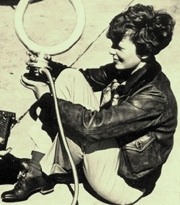 Receive-Only RDF ~~~ To establish a course
directly toward Howland Island, Amelia
Earhart would need to operate an RDF
antenna, which is the loop being displayed
on the right and visible as it was mounted
atop the Electra in the photograph above.
With an appropriately tuned radio receiver,
she would be able to rotate the loop to "get
a minimum" signal and thereby determine the
direction from which a radio signal is being
transmitted. Using that bearing
angle, the Electra would be turned to take
up a heading
directly toward the source. In this
mode, airborne RDF equipment operates
"receive-only" -- simplex
in radio parlance. However... Receive-Only RDF ~~~ To establish a course
directly toward Howland Island, Amelia
Earhart would need to operate an RDF
antenna, which is the loop being displayed
on the right and visible as it was mounted
atop the Electra in the photograph above.
With an appropriately tuned radio receiver,
she would be able to rotate the loop to "get
a minimum" signal and thereby determine the
direction from which a radio signal is being
transmitted. Using that bearing
angle, the Electra would be turned to take
up a heading
directly toward the source. In this
mode, airborne RDF equipment operates
"receive-only" -- simplex
in radio parlance. However...
In 1937, no permanent
radio beacon
was installed on Howland. Such a
facility would be transmitting an
identification signal continuously on a
dedicated frequency identified by Morse
Code. Instead,
the US Coast Guard cutter Itasca
had been positioned at anchor offshore
Howland to support RDF for the Earhart
flight. A qualified radio operator
on board Itasca was supposed to
broadcast an improvised homing
signal in compliance with a time-of-day schedule
on an assigned frequency, with
station identification to be
recognizable by Amelia Earhart -- all by
protocols coordinated in advance of the
inbound flight.
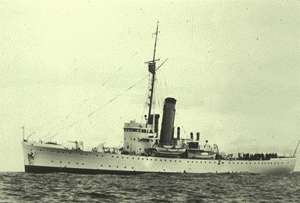 Half-Duplex RDF ~~~ For guidance from the
ground ('DF
steer'), two-way communications had to
be established with USCG Itasca,
which is shown on the right.
Communications were to take place by voice
or by Morse Code on assigned
frequencies. Amelia Earhart would then
be requested over the radio to transmit a
steady signal long enough for the Itasca
radio operator to ascertain the direction of
the source in the sky using a loop antenna
on the ship. Having obtained the bearing
to the Electra relative to the ship's
heading, the operator must compute the
appropriate compass direction for the
Electra to fly and transmit that information
to Amelia Earhart as a heading
by voice or Morse code. All of that
takes time, of course, and all the while,
the Electra would be flying at over a
hundred miles per hour on an uncorrected
heading. Half-Duplex RDF ~~~ For guidance from the
ground ('DF
steer'), two-way communications had to
be established with USCG Itasca,
which is shown on the right.
Communications were to take place by voice
or by Morse Code on assigned
frequencies. Amelia Earhart would then
be requested over the radio to transmit a
steady signal long enough for the Itasca
radio operator to ascertain the direction of
the source in the sky using a loop antenna
on the ship. Having obtained the bearing
to the Electra relative to the ship's
heading, the operator must compute the
appropriate compass direction for the
Electra to fly and transmit that information
to Amelia Earhart as a heading
by voice or Morse code. All of that
takes time, of course, and all the while,
the Electra would be flying at over a
hundred miles per hour on an uncorrected
heading.
In concept, Half-Duplex RDF
operates as a reciprocating, two-way, simplex
system -- half-duplex
in radio parlance. By the way,
wireless telephony, which we take for
granted today, supports what is called full
duplex communications, with
transmitting and receiving going on in
both directions simultaneously. Full
duplex is still not found in radio
equipment on even the most complex
airliners of the Twenty-First Century.
|
As readily seen in the descriptions
above, for RDF to be successful in either mode,
equipment and people on the ground and in the sky must
all be in good working order and coordinated.
Last Words of
Amelia Earhart
The figure below is based on
transcriptions from the radio room aboard the USCG Itasca
standing by Howland Island on July 2, 1937.
These are the last six radio messages received from
Amelia Earhart over a period of two-and-a-half hours
on that fateful day.
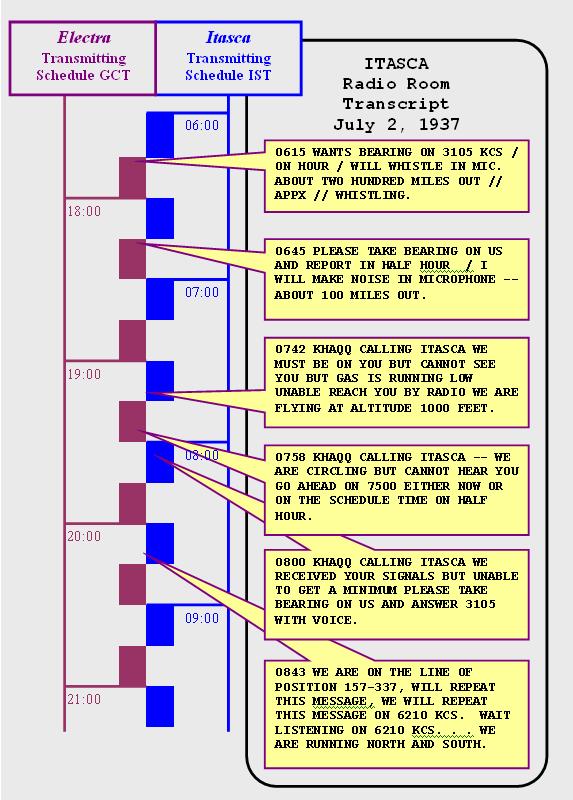
The pre-arranged 'radio schedule'
comprises 'time-slots' during which Earhart was
supposed to transmit simplex at quarter-to and
quarter-passed each hour In between, Itasca
was supposed to transmit simplex on the hour
and the half-hour.
Historians
have
taken special notice of the potential for confusion
resulting from two time-zones: Earhart and Noonan
operated on Greenwich Civil Time (GCT)
while the Itasca clocks were all set on local
time at Howland ("IST" for 'Itasca Standard
Time'), such that IST
= GCT minus
11:30. A source of confusion for sure, but
if everybody stuck to the script, those time-slot
assignments ought to have worked just fine in
half-duplex.
Sophisticated solvers will immediately
observe the following worrisome problems:
- Three different radio frequencies
being called out by Amelia Earhart: 3105, 6210, and
7500 Kcps (thousands of cycles per second, "Hz"
in today's terminology).
- Three different forms of
modulation: "noise," "voice," "whistling" -- but
not "code" (neither Amelia Earhart nor Fred
Noonan understood Morse
Code).
For the many technical issues and facts
beyond those appropriated for Simplexity
Aloft, there can be no doubt that the most
comprehensive reference in all of Amelianna
is the fascinating e-book entitled Amelia Earhart’s
Radio: Why She Disappeared by Paul Rafford,
Jr.
Complexity
trumped simplicity for Amelia Earhart and Fred
Noonan that day, hence the appropriation of "simplexity"
in the title of this puzzle. As the Electra
approached the end of its final flight, a lot could
go wrong. And apparently did.
|
How
many critical issues can you
identify by parsing the last words of
Amelia Earhart?
|
GO TO SOLUTION
PAGE

|