
Copyright ©1997 by Paul Niquette. All rights reserved. |
|
Copyright ©1997 by Paul Niquette. All rights reserved. |
 ophisticated solver will see
that there are really two questions posed in the puzzle. The first was
unasked... ophisticated solver will see
that there are really two questions posed in the puzzle. The first was
unasked...
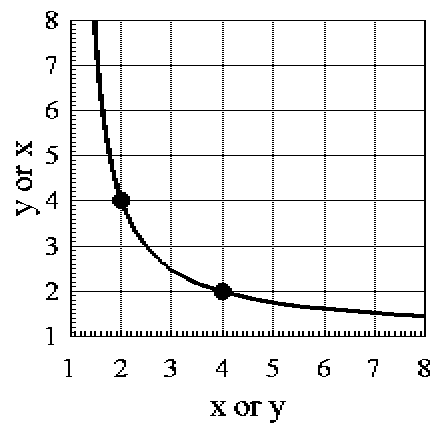
Old Pierre de Fermat would probably approve some experimenting around, like trying a few numbers. The technical term for the procedure is 'foozle.' Truth be known, that's how Pierre got to be known as the most productive mathematician in the 17th Century. Certainly, it was foozling that gave us Fermat's Last Theorem. {BackLink} It does not take the sophisticated solver long to rule out 1 and 2, 2 and 3, 3 and 4. And then, suddenly, there's 2 and 4, so that 24 = 42. Zowie, the numbers 2 and 4 work. An exclamation point is optional. Onward, sophisticated solvers. Onward
to the main question...
A little more foozling and, golly, it does not look like any other pair of numbers will work. Hoo-hah for Fermat's Really Last Theorem.
 xactly as specified in Fermat's
Really Last Theorem, the values 2 and 4 are
indeed a pair of numbers. They are something else, too
-- . You might regard the
previous sentence worthy of an exclamation point. I do.
But I already used one for a sentence like that in Discovering
Assumptons. xactly as specified in Fermat's
Really Last Theorem, the values 2 and 4 are
indeed a pair of numbers. They are something else, too
-- . You might regard the
previous sentence worthy of an exclamation point. I do.
But I already used one for a sentence like that in Discovering
Assumptons.
 et y = kx. Why not? We're just having fun
here. et y = kx. Why not? We're just having fun
here.
(xk)x = (kx)x ~~~~~ by rearrangement, xk = kx ~~~~~~~~~~ after extracting the xth root, and xk-1 = k ~~~~~~~~~~~ after dividing by x.
y = kx ~~~~~~~~~~ by repetition of our starting point,So, where are we? Looks like we can substitute any value for the parameter k and have returned to us the respective values for both x and y that satisfy the original equation. Might give that a hoo-hah, the sound of discovery.
Had Fermat's
Really Last Theorem
used the word 'integers' instead of 'numbers,' as...
...the conjecture would have been disproved anyway.
More than five years after the
publication of Fermat's Really
Last Theorem, a cordial e-mail message was
received from Peter Olsen, a colleague in Australia...
-1 = (i)(i) = [(-1)1/2 (-1)1/2] = [(-1)(-1)]1/2 = [+1]1/2 = +1To avoid making such mistakes when manipulating complex numbers, a strategy is never to use a negative number as a radicand, as for example (-z)1/2. Instead of expressions like that, one should write i (z)1/2, which is the intended use for the imaginary unit i. Finally, using the original formulation of Fermat's Really Last Theorem, x = yx/y , a paradox arises even without using the imaginary unit i, for we see that substituting x = -4 and y = -2 leads directly to... -4 = -2-4/-2...which sure enough conflicts with the algebraic equivalent, xy = yx, for x = -4 and y = -2... -4-2 = -2-4Lurking in hidden assumptions about exponents are anomalies to the nth power. For another example, have a look at those in the solution to Double Integrity. |

|
|
|
|
|
 here is just this one other thing.
  are needs to be
taken when manipulating formulas involving radicals
such as z1/2. The
notation is reserved either for the principal square
root function, which is only defined for real z >
0, or for the principal branch of the complex square
root function. Attempting to apply the calculation
rules of the principal (real) square root function to
manipulate the principal branch of the complex square
root function will produce false results, like this...
are needs to be
taken when manipulating formulas involving radicals
such as z1/2. The
notation is reserved either for the principal square
root function, which is only defined for real z >
0, or for the principal branch of the complex square
root function. Attempting to apply the calculation
rules of the principal (real) square root function to
manipulate the principal branch of the complex square
root function will produce false results, like this...