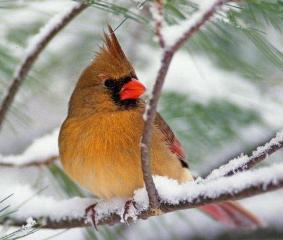
Not all cardinals are red. The yellow cardinal (Gubernatrix
cristata) is a tropical American relative of the
Cardoma Grossbeak, songbird of North America east of
the Rockies (Richmondena, cardinalis), in which
only the male is red, the female mostly brownish.
The Pyrrhuloxia sinuata is a
grayish-red relative found in Mexico and southern
Texas, and the red-crested cardinal (Paroaaria
coronata), a popular cage bird, has become
established in Hawaii.
Cardinals are 20 centimeters (8 inches)
long, with pointed crest. Pairs utter loud clear
whistling notes year round, in gardens and open
woodlands.
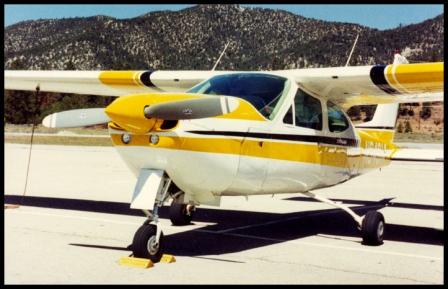
Then there is the Cardinal 177RG (for
retractable gear) made by Cessna. November Three
Four Niner One Four is shown here parked at the
Big Bear Airport in California in 1987.
With raked windscreen and streamlined
fuselage, with strutless laminar-flow wings and
full-authority stabilator, this plane is slippery as
hell and is decidedly my favorite flying machine.
A flock of birds
a-winging, a cloud beyond that tree,
A contrail in the distance
from the jet that once was there.
Closer up, a light plane's
sound dares yet to part the air.
~
Humming with combustion,
enroute to B from A,
The small craft sings
volition's song, along a swift air
way.
That such is aviation's
best can hardly be in doubt,
Compared to airline
journeys -- Hah! one trip will bear that
out.
~
For, herding hapless
passengers aboard a metal room,
Then plying them with
movies, mints, and cocktails to
consume
Is how the airline people
try to take away your thought
Of flying altogether --
and the tickets that you bought.
~
The view you get through
windows like a sideways oven door
Makes flight by jet so
dreadful dull, no wonder most deplore
Airline trips to anywhere
-- and getting there as well:
Extruded to a noisy place
with turning carousel...
~
To stand and stare at
stainless steel and floors of asphalt
tile.
No surprise to me, you
seldom see passengers who smile.
Slogging down the
corridor, who once were straight and
proud,
Their pilots, too, are
counted now amongst the sullen crowd.
~
Constrained by rigid
schedules and instruments galore,
The driver of a wing-ed
bus finds time aloft a bore.
For they're not free to
take a plane and point it at the sky,
To fly to where they want
to go, then land there by and by.
~
And military pilots think
that flying's what they know,
Except they dare not
wander far from where they're told to
go.
Astronauts aren't flying
-- no! -- they float around for days
Inside a metal cylinder to
measure solar rays.
~
They squeeze their food
from bottles and talk in TLD's
(Triple Letter
Designators), 'space speak,' if you please.
The truth concerning space
craft, from all that we can learn:
Computers do the steering
from blast-off to return.
~
Real flying, then, is what
is done by light plane; that's a fact.
Controlled by private
pilot bold, who finds that in the act,
He or she admires the
scene above the nearby earth,
Free to steer a course at
will, fulfilling dreams from birth.
~
One zooms above all
worldly cares -- yes, Freedom is the
word.
Command a hundred horses,
outperforming any bird.
To distant destination
fly, in just a little while.
Then throttle back,
descend, and land, arriving there in style.
~
Scan the sky above you.
Oh, what wonders you will see!
A flock of birds
a-winging, a cloud beyond that tree,
Yourself, perhaps,
a-winging toward a chosen place up
there.
Closer up, your light
plane's song dares yet to part the air.
Bottle
to Throttle
There are two schools of
thought about the effects of alcohol.
One asserts that the
liquid imposes its own 'personality' upon
the drinker -- that a person should not be
held accountable for his or her behavior
'under the influence' ("It was the booze
talking. If I were sober, I would say no
such thing").
The other view of
alcohol holds that it dissolves
inhibitions, revealing the true, otherwise
hidden personality.
Whether there will ever be a
critical experiment that settles the matter I
do not know. However, when it comes to
aviation safety, the debate may have more than
academic significance.
Federal regulations forbid
flying less than eight hours after drinking
("Eight hours from bottle to throttle," the
saying goes) or when 'hung-over' (whatever that
means). There is ample reason for you to
hope, however, that the stranger piloting
your airliner is a teetotaller -- or at
least has abstained for more than the
minimum eight hours.
Objective experiments over
the years have shown that, depending upon
all the familiar variables, alcohol can
adversely affect the pilot's capacity to
perform functions essential to flight safety
up to -- now get this -- more than two days
following its consumption.
So much for assuring the
capacity to perform. But what about the
pilot's personality?
If alcohol is -- in and
of itself -- responsible for unseemly
behavior, then purging the system of the
stuff should restore the pilot to safe
conduct.
On the other hand, the
pilot may have a perilous ego-state
lurking beneath the surface, kept in check
by sobriety. The 'whoopee factor,'
folks.
If the second theory is found to
prevail, then air carriers should consider
adopting the practice of the craftiest
corporate headhunters and surrepticiously
administer alcohol as a clinical device for
pilot screening.
Fiascos
in the Sky
Airliner flies into a
swamp at night, while all three members of
the flight crew are preoccupied changing a
lightbulb on the control panel.
Airliner plunges
thousands of feet before a
fuselage-bending recovery, because pilots
disabled warning devices in order to goad
the plane into a treacherous 'corner' of
its flight envelope.
Airliner descends out of
a storm and proceeds to land at the wrong
airport, the pilots complaining later that
both aerodromes have the same runway
layout.
Airliner cruises twenty
minutes beyond a shoreline destination
over open water, despite radio calls from
radar controllers, because the flight crew
was fast asleep.
Airliner wanders off
course into hostile airspace -- or the
airspace assigned to another airliner --
because the crew did not key in the
correct navigational coordinates.
Airliner runs out of
fuel despite instrument warnings and
protests by the flight engineer, which are
overruled as a matter of prerogative of
the captain.
Airliner loses power
from both engines after take-off and
nearly glides into the ocean when pilots,
responding to a warning, inadvertently
operate the wrong engine controls.
Airliner at 37,000 feet,
with its captain in the restroom and thus
locked out of the flight deck, suddenly
drops 5,000 feet as the copilot, in
adjusting his seat, inadvertently pushes
the control column.
Airliner crashes on
takeoff as flight crew misinterpret
readings from engine instruments or skip
an entry on the checklist calling for
take-off flap setting or...
For reasons that should be
apparent to readers of these chapters, I am
hardly reassured by the realization that
airline pilots are made out of the same
protoplasm as I am.
Surrendering
Control
Airline travel is
unavoidable. As a passenger, one feels
utterly powerless, dependent. I wonder what
the statistics are for the number of
passengers who, as their plane pulls up into
the sky, plunge into a pool of frantic
awareness that their destiny has been
wrested from them.
Ominous thoughts torture the
mind. If those guys and gals enclosed in
their locked compartment up front should
suffer a lapse in competence, become
distracted, get their priorities wrong, make
a crucial mistake aloft -- cripes! -- I
can't do anything about it.
Sure, you ask yourself, what
are the chances of that? Professional
training and practiced skills, checklists
and check-rides, discipline and dedication
-- all act in superposition to make making
mistakes unlikely.
Gulp, but not impossible.
This issue like so many
others in our complex, interdependent world
has become all statistical. Whenever
I am at the controls, however, statistics
lose their hold on me. Probabilities become
mere abstractions. I am the one tilting the
yoke and pushing the pedals. Averages have
nothing to do with the enterprise. Whatever
adverse conditions arise, I know that I have
the power in my own hands to deal with them,
to influence the outcome. Numbers apply only
to others, not to me.
Egg
Plant on Wheels
"Where you headed?" asked the
FBO in
Needles, while pouring lemonade for the
children. He was the archetypical jolly
big-man in middle years. His office in the
tiny building beside the ramp was a clutter
of airplane parts and papers. Faded photos
lined the walls.
"Torrance Airport," I
answered.
"Hell, you ought to take a
swim and relax right here," he said, mopping
his brow with a rag.
"My family and I have just
flown in from Carlsbad Caverns, so --"
"Good motel in town. Five
minutes away."
I shook my head. "It's been a
long trip, and -- "
"I'll even let you drive my
'egg plant.'" The fellow pointed with his
thumb over his shoulder and watched my
reaction.
Parked outside the window was
a 1948 Cadillac limousine. Deep
purple.
"Got a chauffeur's cap?" I
asked.
Prank in
the Sky
Reminiscence
Alert: Sharing technical
features of flight
with a first-timer in the cockpit provides great
entertainment for every old-time pilot. I
especially enjoy giving elementary demonstrations in the
sky.
Beginning in straight and
level flight, I exult about the cockpit's
distinguished view of the world. I gesture at
the control
wheel and gently pull back, raising the nose and
making the passenger in the seat beside me feel
momentarily heavier. Pushing forward results in
wide-eyed weightlessness. Finally, I bank
the plane left and right using coordinated turns.
No surprises there.
“Go ahead, try it yourself,” I say with
a shrug. I ceremonially withdraw my hands from
the wheel and my feet from the rudder
pedals.
Parenthesis. The first
thing passengers observe is that the flight controls
seem to be interconnected in crazy ways. Whereas
the plane responds to the control wheel with banking
as expected, at the same time there is a bewildering
effect called adverse
yaw. It’s as if an invisible foot has
mischievously trounced a rudder pedal.
Of course, during my little flight
demonstrations, I deliberately coordinate aileron
and rudder control
pressures, concealing these strange doings in the sky,
thus setting the stage for discoveries by the hapless
first-timer.
That's not a prank. No,
definitely not. I have played only one prank in
the sky...
It was in 1967, soon after I got my
pilot's license. On a Saturday morning three
colleagues from the office were my passengers aboard Two-Four Fox. We departed Torrance
Airport (now Zamperini Field) for Bakersfield
Municipal Airport to do some rafting on the Kern
River. Our route enabled us to do plenty of
sight-seeing along The
Grapevine above chrome-to-chrome traffic on Route
99.
In the front seat beside me sat Engineer
Ed, a serious fellow, who the week before seemed quite
uneager to go aloft in a single-engine flying machine
with a low-time pilot. He liked river-rapids,
though, and did not want to miss out on the fun.
Now he was craning and gaping and laughing along with
the rest of us.
Approaching Bakersfield, I made an early
descent to pattern
altitude, which gave us a close-up view of the San Joaquin
Valley. The airport came into view five
miles ahead. I obtained permission for a left base entry and
took up a heading of 070, which was perpendicular to
Runway 34 at some distance from the approach end.
Dropping his bravado, Ed squinted straight ahead through
the windscreen. I did the
same. "See it, Ed?" I asked with
a frown. He leaned forward and shook his
head. Of course, he
could not see the airport. It was off to our
left. Houses and trees
swept passed our side windows.
With my right hand, I began
briskly working my way down the laminated checklist on
my knee-board, adjusting throttle and trim, shoving in
the propeller control and the red mixture knob, all
the while seeming to ignore the expanding scenery
ahead. As I lowered the flaps, the plane pitched
forward and our airspeed slowed to a whisper.
With the runway in the corner of my eye, I reduced
power. Ed frantically gripped his seat cushion
with both hands. The cabin became
quiet except for the conversation between the guys
in back. At the last second, I racked
the plane into a left turn and planted the wheels on
the pavement.
Rolling along the runway and chortling, I
brought the flaps up and looked over at Ed. He was
pale and grimacing. I saw pain in Ed's eyes.
The man had been deeply horrified by those last
seconds. He found it difficult even to smile
during the rest of the trip. So did I. This
despite the white-water high-jinks and the raucous
paddle-splashing between rafts in calm pools.
Returning to the airport, Ed accepted my solemn apology
for the prank and bravely buckled into the backseat for
the flight home.
Essential
Flying
February
21, 1987
Anthony
Day
Editor
of the Editorial Page
Los
Angeles Times
Times
Mirror Square Los Angles, CA 90053
Dear
Mr. Day:
One
aspect of Professor Richard J. Vogl's
recommendation that "non-essential
aircraft" over urban areas be banned (in
today's edition of the Times)
warrants careful thought: how to decide
which aircraft are non-essential.
Or
conversely, which flights should be
permitted? Some choices are easy: One
flight last month, for example. A woman I
know flew an Archer to Calexico to bring
back a disabled child for treatment at
Shriner Hospital. Though the flight
"benefits only a few," Professor Vogl
would surely permit it and hundreds of
other flights being made by volunteers on
the American Medical Support Flight
Team.
Business
trips would be all right, too, presumably.
My most recent flight was a quick hop in a
Cutlass from Orange County to Santa
Monica. One of our best customers, an
aerospace company, was having a technical
problem, so I brought in some special gear
and one of our best engineers. Problem
solved.
But
what if it were a candy factory instead? A
business flight to fix a problem there
would be "non-essential," I expect. Last
thing we Americans need is more cavities.
Same for a sales trip to, say, a cosmetics
firm or a movie studio or a maker of
vaginal sprays. Professor Vogl would
doubtless ban private flights for
non-essential businesses.
-1-
No
reason to limit the ban to private flights,
though. For, as Professor Vogl emphasizes:
"Limitation is the mother of good
management!" That most airline seats are
occupied by persons taking non-essential
trips is a reality of aviation.
Check
the couple sitting next to you: why,
they're going skiing. The people up front
with the crying child are on their way
back from visiting Grandma. Hah! And that
thumper behind you? He is bound for a
convention in Chicago -- for
confectioners. Sometimes the skies above
Los Angeles are full of airliners each
filled to capacity with non-essential
travelers to and from places like Reno and
Las Vegas. Let's ban those, too.
Having
cleared the skies of all non-essential
airplanes, we can apply Professor Vogl's
ban in other realms. Think of all the
non-essential vehicles on our neighborhood
streets and freeways. Trips to the beach
would be first to go. And why should beer
trucks take up space on our highways?
"Individual freedom," asserts Professor
(of Biology) Vogl, "must often be
forfeited for the common good." His noble
words taken seriously could get him
grounded, though. Aviation regulators may
someday decide that biology is
non-essential.
Sincerely
yours,
Paul
Niquette
Vice
President,
American
Automation
-2-
Under
the Hood
Penny taught me a
whole lot about instrument flying.
There was this time when we flew to El Toro
Marine Base to practice a procedure called GCA,
Ground Controlled Approach.
Penny scheduled me for six
approaches one beautiful Saturday morning.
As usual, I put on the hood
before take-off from Orange County
Airport (now John Wayne). I contacted the El
Toro Marine Base by radio after we were
aloft.
"We will be using student
controllers for your practice approaches
today," said a deep voice on the radio. I
changed frequencies as instructed and
lowered my seat in preparation for the
effort that lay ahead.
My first approach was
routine. The young marine on the microphone
performed flawlessly.
"Do not acknowledge my
transmissions unless advised to do so," he
told me at one point. "Please acknowledge,"
he advised.
"Will not acknowledge," I
acknowledged.
"You are right of the
approach course. Turn left, heading 340. You
are below the glide-slope. Stop your
descent. You are on the approach course.
Turn right, heading 350. Above the
glide-slope, descend at 500
feet-per-minute..."
The instructions continued in
a steady stream. Then, the controller made
an abundantly sensible statement.
"Your landing gear should be
down and locked; please acknowledge."
"Gear down and welded,"
I chuckled into the microphone.
At the last moment, about a
hundred feet above the runway, I was
instructed to power up and execute a 'missed
approach' procedure. Unless it were a real
emergency, civilians cannot land at El Toro.
For the second approach,
Penny concealed my direction gyro
by covering its face with a jar-lid. I told
the student controller about my predicament.
After a delay, during which I assume there
was a scramble to look up the appropriate
procedure, the controller came back on and
began a more detailed set of instructions.
They included commands of the form, "Turn
right -- stop turn."
So it went. Penny would cover
up various instruments, and I would obey the
commands issued from the ground. She brought
plenty of jar-lids. The fifth time around,
Penny set up a 'no gyro approach.' About all
I had to look at on the control panel was
the oil pressure gauge. This really put the
onus on the GCA controller.
How neat to pop up the hood
after such a hairy simulation and see the
runway directly under my nose wheel! I had
an idea.
"Care to try one, Penny?"
Penny laughed. "The fantasy
life of every instrument student includes
getting his instructor under the hood." I
determined not to touch that line with a
barge pole. "Gimme that thing," said she.
Penny adjusted the headband
and pulled the hood down to obscure the
window. I sat back and folded my arms. For
the first time that morning, I would be
permitted to experience the visual reality
of flight.
A new controller took his
turn at the GCA scopes. He was less sure of
himself than his predecessor. I left all the
jar-lids in place for Penny.
Things went fine in the
beginning. Penny reduced and increased power
on command. She turned and stopped turn,
first this way then that. I was astonished
at the magnitude of the corrections being
made. We were flying all over the sky. What
a lark. Then something went wrong. We were
no more than 300 feet above the runway and
slightly to the right.
"Increase power. Turn left.
Reduce power..."
The student controller forgot
to say, "Stop turn."
We continued to turn left.
Penny knew something was wrong. The runway
drifted off at a crazy angle to our flight
path. There were buildings, including the
control tower, dead ahead. I didn't say a
word. The radio went quiet.
Penny stopped the turn on her
own. But, without gyro instruments, she
could not tell which way we were flying. She
gripped the throttle, knuckles white. By
then, Two-Four Fox had to be off the GCA
radar screens. Two hundred feet, descending.
Tower less than a quarter mile away.
Parenthesis. The hood is a
simple plastic contraption. If you want to
see out the window, simply take it off with
the flick of your wrist. Mine, in fact, was
the deluxe model, with hinges at the
temples, which enable the pilot to tilt the
hood up at the last moment for the landing flare.
Penny made no move to lift
the hood. This tells you a lot about Penny
-- and a lot about instrument piloting. It
is an awesome responsibility, outranking
open-heart surgery. In a practice exercise,
you don't cheat.
The tension mounted. Penny
cried out, "My God! Don't let us crash!"
I was on the verge of taking
the controls when Captain Deep-Voice called
on the radio with instructions to execute a
missed approach, starting with a climbing
turn to the right.
Even then, Penny did not lift
the hood.
Hangar
Wedding
A wedding in a hangar, with
airplanes and aviation enthusiasts all
around. Got it? It was in
1990. Now, try to imagine that I might
have been invited to give a talk. Oh
sure. Are we on the same page
here? Now this: A short
talk. Yeah, right. Here's the
text...
Standing here in this
environment puts me in mind of -- well
flying, and I am reminded of the three
most useless things for a pilot: the
runway behind you, the altitude above
you, and the fuel not put in your
tank.
A
little like marriage, don't you
think? The three most useless
things in a marriage: the grievances
behind you, the expectations above
you, and the affection not expressed
to your mate.
As for the inevitable question
about the couple, far as I know, they are
still married to each other. In my case,
though,... never mind.
Ground-Fog
Day
"Read-back correct. Call
again when ready to taxi."
Ground Control cleared us to
Runway Two-Niner Right. I released the
brakes and started an exceptionally slow
taxi.
"Reminds my of that morning
at Orange County, Harv," I said, peering
intently through the damp plexiglass. "Did I
ever tell you?"
"The time with the PSA jet,"
he answered. My son, alas, has heard all my
stories.
"What happened with the jet?"
asked Murray from the back seat.
"Nothing much," I answered.
"It was my regular morning commute out of
Orange County. We had this patchy advection
fog that morning, and -- "
"Advection?"
"Fog blown in from the ocean.
It is thin and streaky. Never very high,
though. You're in the blue just a few
seconds after lift-off. Anyway, I was
creeping along the taxiway about like this.
I turned the plane into what I thought was
the run-up area when all at once out of the
soup appears this big silvery, sphere-like
thing with a light on it and a black patch
in the middle -- "
"Radar dome," explained Harv.
"I had missed my turn and
come face-to-face with this PSA jet. He was
sitting there on the ramp. Waiting for the
fog to clear before loading passengers, I
guess. By the time I stopped, I was too
close to turn around."
"Can't back this thing up, I
guess," Murray commented.
"I reported to Ground Control
that I had traffic, twelve o'clock, at my
altitude."
Harv chuckled. "My dad had to
shut off the engine and push the plane back
by hand."
"Not before doing my Buster
Keaton routine for the benefit of the PSA
flight crew. Made'em laugh so hard, even in
the fog, I could see the fillings in their
damn molars."
Perfect Flight
Foremost,
you don't just climb in and take off. The
preliminaries are more than obligations.
For one who would be joyfully
conscientious, all those preludes add
satisfaction to the quest.
Take inspection, for example.
Who can deny the gratification experienced
by alert fingers diligently stroked along
the smooth surfaces, assuring unblemished
form! Indeed, you eagerly inspect each
fillet and recess. Who can resist the
fascination with features seemingly shaped
as pleasure for the eye more than purpose
and function!
Ah, but now you have assured
a state of readiness. With a audible
sigh, you liberate the vital elements of
motion. Only then do you deign to enter that
most privileged realm. You set loose
the noisome thrust with alacrity and escape
the hold of earth, rising up to meet the
sky.
Still, you must take care to
guide the enterprise along the intended
course. Precision and purpose characterize
every movement, whether gentle or firm.
Wonder attends your progress. Perfection
means that upon arrival at a distant place,
you descend reluctantly from the pleasured
heights to find renewed contentment below.
Thus does flying
spoil you for any other activity. Well,
almost any other.
What sets perfect flight apart
from perfect something else is that afterwards
you go out and tell your friends about it.
Pope
Soap
During Pope John Paul's U.S.
tour in 1987 (September 10-19), a number of
commemorative products sprung up.
Coffee mugs, ceramic tiles, and barbeque
aprons were everywhere featuring images of
the Pontiff. Sears had a sale an
animated lawn sprinkler inscribed with "Let
us spray." There were molded cleansing
agents made from the salts of vegetable fats
("Pope Soap").
My
favorite included a loop of nylon cord to be
conveniently suspended on a shower head --
yeah, "Pope Soap on a Rope."
Now a flying story...
A late-night fuel-stop in
Cardinal Three Four Niner One Four at a
remote field in Nevada found the flight line
closed and the FBO
unavailable until morning, which
necessitated an unplanned RON.
At
the closest motel, a toothless codger with a
scruffy beard handed me the room-key and a
fresh towel.
"Do you have any Pope Soap on
a Rope?" asked I with a grin.
The old fellow shrugged as if
he had been responding to the question all
week. "Nope."
Here
is an
'anecdote in the sky', dating back to a short
flying adventure in 1969. The experience
will continue to be relevant as long as the winds
blow. It features a two-hour
family flight at night from Paso Robles Municipal
Airport to Orange County Airport
(now John Wayne Airport) in one exceptionally
brisk Santa Ana wind.
Our Skylane
boasted an ‘honest’ sea-level airspeed
of 140 mph (120 knots). In compliance with
the semicircular
hemispheric rule,
my VFR
flight plan was filed for a cruising altitude of
13,500 feet in order to have a smooth ride.
Our intended course
was about 135 degrees magnetic on the leg from
overhead Santa Monica Airport
to – well, to Santa Ana,
come to think of it. The air was smooth as a
putting green, and my passengers were sound
asleep. Their pilot in command (that would
be me) was periodically ‘sipping’ from a fresh
bottle of oxygen lying across my lap -- a
practice attributable to the chapter entitled
Pattern Altitude.
Pilots know that winds aloft
increase in speed with altitude above the
surface. Higher always means faster.
Our planned heading included a cross-wind correction
angle of maybe 15 degrees. Not enough: Me
and my passengers were being blown out to sea
abeam the San Fernando Valley.
About
then, I became vividly reminded of a worrisome
anecdote by Antoine
de Saint-Exupéry
in Wind, Sand, and Stars,
describing a flight on his mail-route along the lee side
of the Andes in 1935. Our Skylane was
a few knots faster than Saint-Exupéry’s Latécoère 28 (108
knots). Even so…
Those dry easterlies in Southern
California,
warmed by down-slope adiabatic compression, can
reach speeds of 60 knots at the surface (that's
'Category One' on the Saffir-Simpson
scale).
Or fiercer, according to fire-fighting reports
some years. At 13,500 feet over the
coastline, one might experience a ‘straight-on’
headwind of 100 knots. On a ‘radical
slaunch’ of, say, 45 degrees, the cross-course component of our airspeed might
actually be less than 100 knots, as
analyzed in the enigma entitled Wind Circle.
The
solution would seem to be elementary: Descend.
Get down low where the winds blow slow. But
wait…
The TCA
(Terminal Control Area) for LAX
has a ‘ceiling’ at 12,000 feet. That meant
we needed to stay above 12,000 feet within 45
miles of that place to be in compliance with visual flight rules.
I chose another alternative, which was to request
a clearance to use
a low altitude ‘VFR corridor’, which crosses the
runways under the local ‘floor’ of the TCA
at 2,500 feet. That meant beginning our
descent abeam Point Mugu.
And
waking up my passengers in severe turbulence.
Bummer.
Epilog
Forty-eight
years after that flight, record-breaking
wildfires blazed in SoCal
exacerbated by fierce Santa
Ana winds. From his home in
a French village, the author sent a draft of this
anecdote to correspondents@niquette.com proposing the title
-- "No Shit: There I Was at 13,500 Feet
Being Blown Out to Sea." Some
complained that it was too long.
Not Don
Lauria. My oldest friend sent a
message under the subject title "No Shit:
There I Was at 20,430 Feet" along with a
link to a singular adventure of his own
entitled American
1975 Karakoram Expedition.
Calendar in the Sky
During the 1980's, this was a familiar sight...
It always reminds me of my experiences
as the Commuter
in
the Sky and makes me wonder about all the
changes in the Greater Los Angeles Area that must be
evident from the sky. Perhaps someone will
accept this challenge: Go aloft and shoot pictures
for comparison. The collection would make
a wonderful calendar in the sky, don't you
think? If you want to accept the
challenge, let
me know, and I'll publish your photographs
here.
Phobia in the Sky.
Not all phobias
are irrational.
As observed in Sky
Below, "a healthy fear of snakes or heights might
well be favored in the genes. Indeed, our ancestors in
jungles and mountains who lacked those fears must have
produced few competent offspring." Nevertheless,
flying has a curious power to cancel out -- to nullify!
-- my personal fear of heights. Let this
anecdote, exemplify what may be a common anomaly...
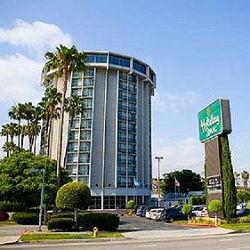
Back in the
sixties, I flew some guests aboard Two-Four Fox to an event at the
Holiday Inn in Long Beach, California.
Approaching the airport, I obtained permission from
the control tower to circle above the hotel, while
descending to 2,000 feet. That’s higher than any
skyscraper on the planet but tame stuff, it would
seem, for one grinning aviator.
After landing, we drove a rental car
to the hotel for a wine-tasting on the top
floor. Of course, it was not permissible for
the pilot-in-command to participate in the sampling
of grape juices that day, so to pass the time, I
wandered outside onto the balcony and casually
glanced down at the driveway below.
Holy shit! I spun away from the
railing and stumbled through a doorway. Still
gasping, I plopped onto a couch surrounded by
astonished guests. What the hell is wrong with
me? I asked myself.
The psychology may be elementary: The
inside of an aircraft fuselage hardly conforms to
primitive paradigms.
At
whatever altitude in flight, we are merely spectators
gaping at abstract images beyond the Plexiglas.
That’s
my hypothesis, anyway.
Holding onto a bannister and peering
down from a dozen floors up is a different
matter. It is utterly real, according
to the medulla
oblongata or whatever ancient subsystem is most
influential inside our respective craniums. If
you know a better explanation, please let me know,
and I'll publish it here.
Departing the TCA,
I received a routine request from Departure
Control. “What are your intentions?” asked
the controller.
That tempted me to make
a wisecrack based on an old joke about a student pilot
who responded, “Well first I’m going to get a pilot’s
license, then I plan to marry my girlfriend and have
children.” But
for just this once I restrained myself. The
controllers in the Boise radar room might not
have been amused.
“Cardinal Niner One Four,
squawk VFR. Frequency change approved.Have a good
trip.”
“Thanks, s’long.”
The rest of the story
is embarrassing. To understand why, one might read Squawk 1200,
which is an e-book mostly about the invention of the
altitude-reporting transponder
back in the late '50s. Either that or simply be
advised that the squawk code
for visual flight rules (VFR)
is – well, it’s 1200. That’s what then
appears on ATC
radar screens to tell controllers to ignore the
associated blip.
At about that moment, I
clapped my son on his shoulder and pointed at the
Idaho foothills north of our course. “Like Baja
in Two
Four Fox, remember?” I exulted over the
intercom. “You were nine years old." I
nonchalantly reached forward and entered 7500 on
the transponder.
Oops, “7500” just
happened to be the number I was watching for on the altimeter
during the climb. It had nothing to do with the
transponder.
Thirty minutes later,
after listening to ATIS
at Friedman
Memorial Airport , I tuned up the radio and
clicked the transmit key. “Hailey Tower, this is
Cardinal Three Four Niner One Four, inbound from the
west, with
your numbers, requesting a straight-in approach
for Runway
One-Three.”
The radio was silent.A minute
later, I repeated the call.
“Cardinal Niner One Four,
we are unable to grant a ‘straight-in’ approach at this
time," said the tower with a
frown in his voice. "Make full pattern
for Runway One-Three.Report turning downwind
abeam.”
It seemed that no other traffic
was being controlled by the tower at that time. My
voice expressed puzzlement more than impatience.
“OK, Hailey, Niner One Four is diverting to the
south. We will make a standard entry for a
right-hand pattern.”
“Roger
that,” said the tower operator. Then after a
pause, he said, “Is everything all right up there?
“That’s affirmative,” I
replied in full grin. “Um...why do you ask?”
“We received a call by
land line from the radar room in Boise,” replied the
tower operator.“They
suggested that you should recycle your transponder.”
I looked at the panel and
immediately saw my mistake.It was for
such an occasion, that the expression “oh-shit” was
invented.
Squawk Code 7500
means “HIGHJACKING IN PROGRESS.”
After my apology over the
radio, the tower operator breathed a sigh of
relief. "Standby while we cancel Boise’s request
for law enforcement officers to meet your plane on the tarmac."
Whew. My son and
his wife might have been handcuffed and searched.That's
embarrassing enough, but I probably would have lost my
pilot’s license or something.
Maybe that wisecrack to
the people in the Boise radar room would have been a
good idea.

 The yellow cardinal (Gubernatrix
cristata) is a tropical American relative of the
Cardoma Grossbeak, songbird of North America east of
the Rockies (Richmondena, cardinalis), in which
only the male is red, the female mostly brownish.
The yellow cardinal (Gubernatrix
cristata) is a tropical American relative of the
Cardoma Grossbeak, songbird of North America east of
the Rockies (Richmondena, cardinalis), in which
only the male is red, the female mostly brownish.
 Then there is the Cardinal 177RG (for
retractable gear) made by Cessna. November Three
Four Niner One Four is shown here parked at the
Big Bear Airport in California in 1987.
Then there is the Cardinal 177RG (for
retractable gear) made by Cessna. November Three
Four Niner One Four is shown here parked at the
Big Bear Airport in California in 1987. 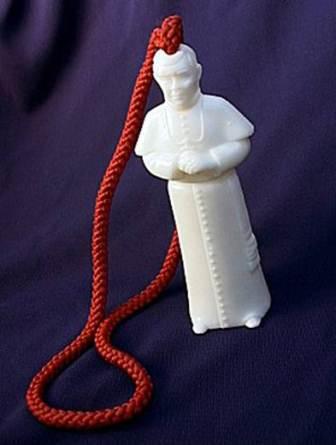 My
favorite included a loop of nylon cord to be
conveniently suspended on a shower head --
yeah, "Pope Soap on a Rope."
My
favorite included a loop of nylon cord to be
conveniently suspended on a shower head --
yeah, "Pope Soap on a Rope." 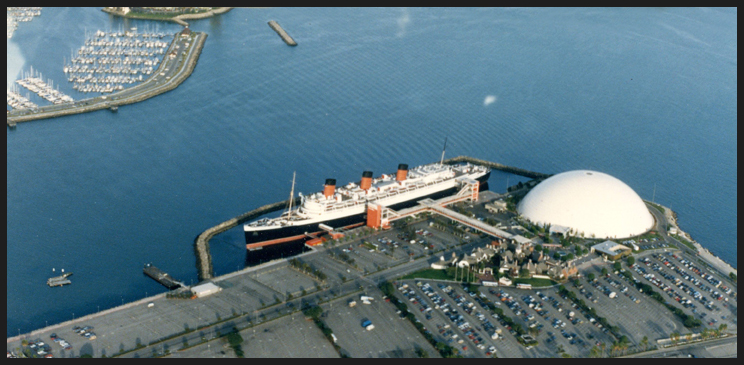
 Back in the
sixties, I flew some guests aboard
Back in the
sixties, I flew some guests aboard